What type of treatment is most appropriate for small water systems?
Sentinel’s PFAS Roughing Filter™ systems can utilize granular activated carbon (GAC) or ion exchange (IX) media, depending on the specific application and site-specific water quality, and both are appropriate for small water systems. Per the EPA PFAS Treatment Fact Sheet: “For public water systems serving 10,000 or fewer people, the EPA designates technologies that are both effective and affordable as Small System Compliance Technologies (SSCTs). The EPA determined that there are available SSCTs for the PFAS MCL which are the same as the BATs, though some of these technologies are only anticipated to be affordable for certain small systems depending on the populations they serve. Anion exchange was found to be affordable for all system size categories, granular activated carbon in most cases for systems serving between 25-500 people as well as in all cases for larger systems…”
Can PFAS Roughing Filter™ systems be used at sites with a traditional lead-lag treatment system?
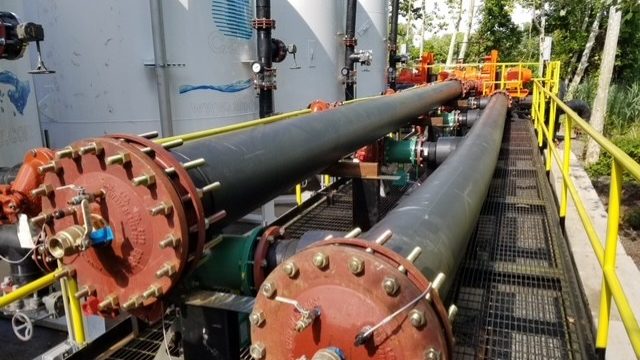
Yes, PFAS Roughing Filter™ systems can be installed upstream of a traditional lead-lag treatment system and provide the same benefits of reduced O&M costs, improved compliance, and quicker media changeouts while reducing the need to change media onsite and backwashing when putting new media into service. In fact, adding a PFAS Roughing Filter™ system ahead of your existing lead-lag system can eliminate the need to perform complicated media changeouts on your large vessels and greatly reduce your overall media usage. In addition, there is more flexibility in the PFAS Roughing Filter™ system design since the larger lead-lag vessels already provide the required Empty Bed Contact Time (EBCT).
Can a PFAS Roughing Filter™ system be used at sites without traditional lead-lag treatment systems?
Yes, PFAS Roughing Filter™ systems can be installed as stand-alone systems that provide improved compliance, reduced O&M costs, and quicker media changeouts while reducing the need to backwash when compared to traditional lead-lag treatment systems.
How much flow can your systems treat?
Our systems can be designed to handle a large range of flows and have a minimal footprint when applied to small- to mid-sized sites with flows under 200 gpm. Flow rates greater than 200 gpm can be treated with multiple parallel units and, similar to traditional lead-lag systems, require a larger footprint to accommodate larger flow rates.
What’s unique about your pilot testing approach?
Our patent-pending pilot test approach is designed to expedite media comparisons similar to a Rapid Scale Small Column Test (RSSCT), but eliminates the need to grind the test media. Media grinding can lead to inaccurate test results, especially when comparing re-agglomerated vs. direct activated GAC media, due to differences in activation in the outer part vs. inner part of the GAC granules.
Why is PFAS treatment so expensive?
It doesn’t have to be! Traditional lead-lag filtration systems have worked well for decades when removing constituents measured in the parts per billion range, but are wasteful when applied to PFAS where drinking water limits are in the parts per trillion range. For comparison, a part per billion is equivalent to 1 second in the past ~32 years, whereas a part per trillion is a single second in the past 32,000 years. Because PFAS constituents are regulated at such low levels and have such a large mass transfer zone (MTZ) within the media bed, the end result is PFAS detections exceeding your drinking water permit when your lead-lag media is only partially used. This was the inspiration for the PFAS Roughing Filter™, which is designed to fully exhaust your media prior to being changed.