Why Pilot Testing Matters
A well-designed pilot helps resolve many variables before committing to a full-scale build. Every source water is different and regulatory requirements vary by state. Site flow rates and space constraints directly shape vessel sizing and system layout, and treatment media such as GAC and ion exchange (IX) resin carry very different footprints and long-term cost implications.
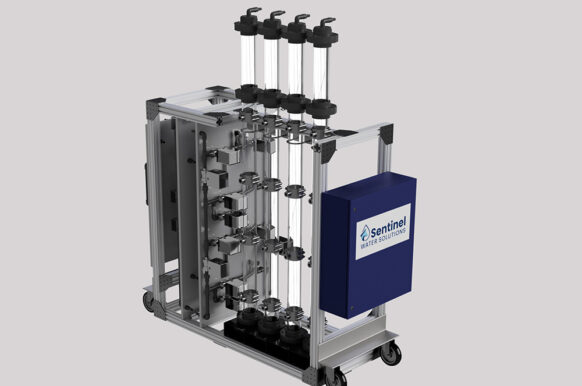
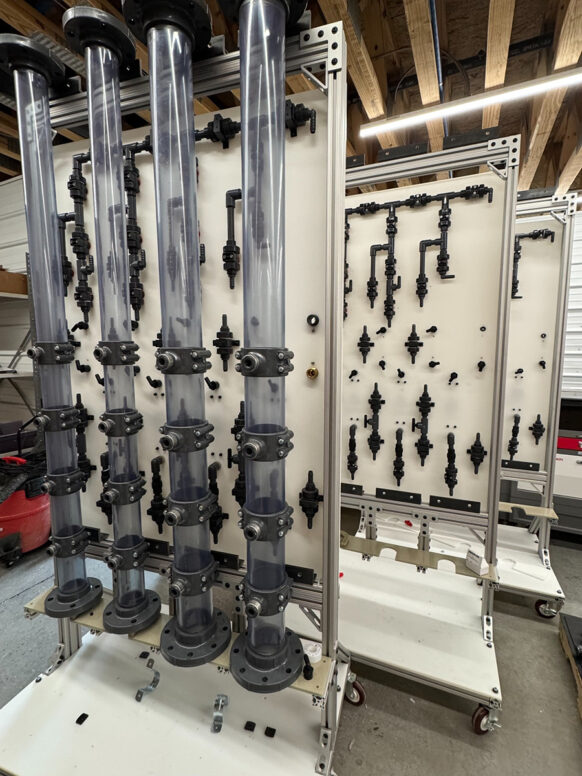
A pilot skid is a compact, rack-mounted system of pipe columns that simulates full-scale treatment vessels at a fraction of the size. Packed with the media under evaluation and fed your actual source water under controlled conditions, it reveals how site-specific water quality affects performance, estimates media life and operating costs, and lets you compare media options side by side before a shovel hits the ground.
The right pilot program, designed with the same rigor as the full-scale system it informs, offers an exceptional return on investment.
The Advantages of a Sentinel Pilot
1. Media & O&M Cost
Select the right media with confidence
Annual O&M, driven largely by media replacement, typically runs 15–20% of initial capital, meaning a facility can re-spend its installation cost on O&M within five to eight years. The gap between a six-month media life and a twelve-to-eighteen-month one is substantial. A pilot gives you the data to choose well before you commit.
2. Sizing & Capital
Optimize vessel sizing and footprint
Media selection dictates vessel size and arrangement. IX resin vessels run roughly one-third to one-quarter the size of equivalent GAC vessels for the same objective. On sites with limited space, that difference can determine whether a viable design fits, a distinction with seven-figure implications.
3. Regulatory
Strengthen compliance and permitting
Some states mandate a pilot before permitting; even where optional, pilot data supports regulators reviewing atypical configurations or unfamiliar media. It can also confirm, before permit issuance, that your chosen media keeps downstream chlorination and corrosion control performing as intended.
4. Verification
Verify performance over time
Online PFAS monitoring at drinking-water concentrations is still emerging, so side-stream skids running parallel to full-scale treatment offer a practical alternative. They provide periodic two-to-four-week snapshots that help operators detect early breakthrough and respond to source-water shifts, especially valuable in wastewater applications.
Considerations We Help You Navigate
A few factors are worth planning for in any pilot program. Here is how Sentinel turns each one into a well-scoped, managed part of your project.
Scope and budget, right-sized
Piloting can be scaled to fit your project. We tailor scope, duration, and configuration to your timeline and budget, so a targeted pilot asking specific questions delivers the answers your design needs at a fraction of the cost of a comprehensive multi-variable study.
Media decisions made early
GAC and IX systems operate under fundamentally different hydraulics and footprints, so settling the media choice early keeps your design clean and efficient. A Sentinel pilot answers the media question up front, giving you confidence in performance well ahead of installation.
Results designed to scale accurately
Empty bed contact time (EBCT) depends on column height and sample-tap placement, details that matter for accurate scaling. Our adjustable columns and custom tap placement are dialed in for your test, keeping your data cleanly scalable to full-size vessels.
Equipment matched to your test, on schedule
As more utilities pilot simultaneously, demand on standardized rental fleets continues to grow. Designing equipment around your objective gives you the configuration your test calls for while keeping your project comfortably on schedule.
Our Approach: Engineered for the Test
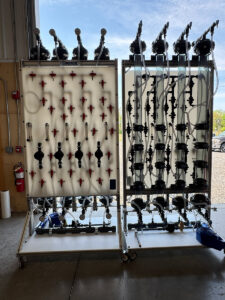 Rather than offering fixed configurations and asking you to work within them, we design each skid around the specific objectives of your test. We start with the questions your full-scale design needs answered, then work backward to the equipment that generates the most relevant data possible.
Site constraints are treated as engineering inputs from the start. Ceiling height, available footprint, access, and operator skill all inform how a skid is dimensioned. In practice, that means:
- Adjustable column height and diameter for accurate EBCT simulation without approximation.
- Customizable sample-tap number and placement, including remotely located valves that improve safety and sampling consistency.
- Media-specific underdrain mesh sizing tailored to GAC and IX media, supporting even flow distribution and protecting the integrity of your data.
- A modular rack-and-panel system built for upgrades, so a skid configured for an initial study can be adapted for ongoing process verification as your system matures.
When your engineering consultants arrive with a test objective already defined, we configure a skid to meet it. When they come earlier in the process, we draw on full-scale treatment experience to help define the right questions first, then build the equipment to answer them.
How a Pilot Program Works
Step 1 - Define the questions
We start with what your full-scale design needs to answer, including media selection, sizing, regulatory needs, and site constraints, and translate them into clear test objectives.
Step 2 - Configure the skid
Working backward from those objectives, we select a base model and dial in column geometry, sample taps, and underdrain sizing for your specific media and site.
Step 3 - Run and sample
Your source water flows through the skid under controlled conditions, with sampling resolution set to capture breakthrough and media performance accurately.
Step 4 - Inform the design and beyond
Pilot data feeds directly into your full-scale design and permitting. The same modular skid can then transition to ongoing process verification as your system comes online.
Let’s Design Your PFAS Pilot

Talk to our pilot team.
Start with the questions your full-scale system needs answered, and let us build the skid that answers them. A focused investment today gives you the data you need, so the design that follows rests on a far more solid foundation. Or call 888-811-PFAS.
"*" indicates required fields