Why the right answer for PFAS removal depends less on the equipment catalog and more on the system engineering behind it.
Most equipment decisions in the municipal water industry start the same way. A utility identifies a need, a vendor proposes a system, and the conversation quickly moves to specifications, pricing, and delivery. For decades, that process has favored a single answer: the standard, off-the-shelf system. It is a model the industry has come to trust, and for good reason.
PFAS is changing that calculus. As utilities across the country confront new federal maximum contaminant levels and looming compliance deadlines, many are discovering that a treatment challenge defined by site constraints, variable source water, and unforgiving performance requirements does not always fit neatly into a catalog. The question facing a growing number of utilities is no longer simply which system to buy, but whether a standard system is the right tool for the job at all.
This article looks at the genuine trade-offs between standard and custom-built treatment systems, what each does well, where each falls short, and why PFAS in particular has pushed more utilities to take a serious look at custom system engineering for the first time.
The Case for Standard Systems
There is a reason standardization has dominated the water industry. A manufacturer that produces a consistent line of systems builds enormous efficiency into everything it touches. Supply chains are predictable, components are sourced in volume, and the engineering is largely settled before a single order comes in. That translates directly into advantages a utility can feel:
- Lower upfront cost. Volume purchasing and repeatable designs keep capital costs down and quotes competitive.
- Speed and predictability. When the configuration is already worked out, lead times are shorter and there are fewer surprises in fabrication.
- Proven, repeatable performance. A system that has been built hundreds of times carries a long track record behind it.
- Simpler procurement. Fewer custom variables mean a more straightforward path from specification to delivery.
For many applications, those benefits are decisive, and a standard system is simply the smart choice. The limitations only emerge when the application stops cooperating with the catalog. A standard system carries fixed assumptions about tank height, footprint, nozzle and access locations, and pipe runs, and those assumptions are baked in long before a utility ever calls. When a site cannot accommodate them, the utility is left adapting itself to the equipment rather than the other way around.
As one industry veteran put it, the software world offers a useful parallel. A generalized, off-the-shelf product is built to serve everyone, which is exactly why it costs less and why it rarely fits any one customer perfectly. You save on the upfront price, but you pay later in the work of adapting the solution to your particular needs. A purpose-built solution flips that equation: it is adapted to you out of the gate.
Why PFAS Changes the Equation
The water industry has historically been cautious about anything custom, often defaulting to the belief that standard is safer until a problem becomes painful enough to justify a different approach. PFAS is proving to be exactly that kind of problem.
PFAS treatment projects are multifaceted and multidisciplinary in a way that routine filtration and specific contaminant removal projects are not. The right design depends on the interplay of water quality, media selection, hydraulic loading, site logistics, operator capabilities, and long-term economics, and those variables rarely line up the same way twice. A configuration that is ideal for one utility can be impractical for the one down the road. That complexity, combined with the regulatory pressure now bearing down on utilities, has made more decision-makers willing to consider a system engineered specifically for their conditions.
This is especially true for the smaller and mid-sized municipal systems that make up a large share of the affected market. These are often the utilities with the tightest sites, the most variable source water, and the least margin for an oversized or poorly fitted system, and they are precisely the utilities a standard catalog serves least well.
What “Custom” Actually Means
Custom is an easy word to misuse. It does not mean reinventing the individual components of a treatment system. At the component level, these systems are still built from the same fundamental parts: tanks, pumps, valves, and media. The customization happens one level up, in how all those parts are integrated into a complete system that solves a specific set of site constraints, treatment objectives, and operational and financial goals.
In other words, the value of a custom approach is not custom hardware for its own sake. It is custom system engineering and custom program engineering. The conversation begins where every treatment project does, with water analysis and flow rates, but it does not stop there. It quickly moves into a more holistic picture of what the utility is trying to accomplish.
Designing around the realities of the site
A genuinely custom process digs into questions a standard configuration cannot fully answer. A supplier of standard equipment can certainly ask them; the difference is whether the system can be shaped around the responses. What are the utility’s operational capabilities once the system becomes theirs, and how should that shape the complexity of the design? What are the site logistics for getting equipment in and out? Is there room for laydown areas and media replacement, or is this a candidate for a vessel-swap program? Is there space to store backwash water? Each answer steers the design, and each is unique to the site.
Media selection follows the same logic. Water quality should drive most of the choice between media, but it is not the only factor. On the carbon side, the economics of reactivation, proximity to a kiln, the volume of media a program can produce, and the trade-offs between virgin and reactivated carbon all factor into a decision that a capital-cost-only lens would miss. Ion exchange resin carries its own distinct set of selection criteria. The choice between a PFAS-selective resin and a less expensive non-selective one turns on the background water chemistry, because competing ions such as sulfate, nitrate, alkalinity, and organic carbon can shorten run length and drive up changeout frequency on a resin that is not built to tolerate them. Because most PFAS resin is single-use rather than regenerated, the spent-resin disposal pathway and its cost become a central part of the lifecycle economics rather than an afterthought. And where short-chain compounds such as PFBA or PFBS are present, resin chemistry may be selected specifically for the performance advantage it can offer on those harder-to-capture fractions. A custom process weighs a far wider set of parameters than a standard specification typically accounts for.
Matching the vessel to the application
Vessel selection is a clear example of where one size does not fit all. Steel vessels with traditional epoxy coatings tend to make the most sense once diameters reach roughly the 36-inch mark and above, where their pressure ratings, fabrication options, and economics line up. Below that, the picture changes. At small flow rates, the availability and economics of steel become challenging, and the alternatives on the market often feel residential in nature rather than built for the demands of PFAS treatment.
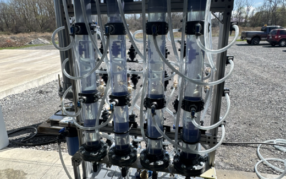
Fiberglass-reinforced plastic, or FRP, still has its place, particularly for short-deadline temporary installations where low cost is the priority. But for permanent installs, FRP carries real drawbacks, including limited access for underdrain maintenance. Recognizing this gap, some providers have engineered purpose-built polymer vessels to serve as a Goldilocks option between FRP and steel in the smaller size ranges, designed specifically for PFAS treatment rather than adapted to it. The point is not that one vessel type wins. It is that the right answer depends entirely on the application, and a process that can choose among them serves the utility better than one locked into a single option.
Enclosed or exposed: a deliberate trade-off
Even the decision to enclose a system is a design judgment rather than a default. There is a cost paid one way or another: enclose the system and the spend shows up as capital expense; leave it exposed and it shows up over time in operations and maintenance, in the form of corrosion and freeze-thaw risk. In the Northeast and Mid-Atlantic, where a single freeze event can damage a system and trigger an unexpected cost, an enclosure is often the right call to prevent unplanned outages. One such reason is a mobile vessel-swap configuration, where a permanent building would get in the way of removing and placing tanks. The right answer, again, depends on the specifics.
The Discipline Behind a Custom Build
The hesitation many utilities feel about custom systems usually comes down to a single fear: that custom means improvised, and improvised means risk. That fear is legitimate when custom work is done the old way, figuring it out on the shop floor. It evaporates when custom work is backed by modern design discipline.
The single biggest differentiator in a well-run custom process is that nothing is left to be sorted out during fabrication. Everything is designed in 3D before it is built. When a system involves choices about flow splits, the number of parallel trains, the number of vessels per train, tank access and nozzle locations, valve tree placement, and the pipe runs connecting all of it, those decisions are exactly the kind that go wrong at the site if they are not verified in advance. Designing the full system in three dimensions confirms, before anything is fabricated, that a tank access point is not obstructed, that nozzles align with valve trees, and that the layout fits the intended space.
That discipline extends to structural and hydraulic performance. Rather than relying on the old habit of making components bigger and heavier just to be safe, a rigorous process verifies designs with analysis software, using finite element analysis for structural loads and computational fluid dynamics for flow, checking what can be checked at the design stage every time. The result of all this front-end work is a complete, highly detailed design package, down to every pipe support and fastener location, that goes to the manufacturing floor with nothing left ambiguous.
A fully resolved design package pays a second dividend that utilities rarely see but always benefit from: control over procurement. When every component is specified up front, parts can be sourced from vendors that already understand the spec they need to meet before they ever ship a component. In systems that integrate this many parts, a disciplined, buttoned-up supply chain is just as important to the final quality as the system design itself.
When Custom Is the Only Answer That Fits
Consider a utility facing a compliance deadline it was not going to meet without help, on a development site with significant space limitations. The need was not simply a temporary treatment system; it was a temporary system that could physically fit a constrained site and stand up to extended use. Working from site visits, photographs, and satellite overlays of possible equipment locations, a custom trailer-mounted build was engineered and fabricated on an aggressive schedule, delivering full PFAS treatment capability as a stopgap to a permanent installation.
Almost nothing about that build was off the shelf. Considerations ran down to the height of the air release valve on top of the tank, to ensure the assembly would fit the available space. Custom access hatches were cut into the trailer to allow for future media replacements, and structural reinforcements were engineered to support the weight of the treatment system and to allow the tanks themselves to be removed if ever needed. The result was a system robust enough to remain in service well beyond its temporary mandate, the kind of quick-deployment build a less agile provider simply could not have delivered. That is the practical difference a custom approach makes: not a fancier system, but the only system that fits the problem.
Choosing the Right Approach
None of this makes custom universally better than standard. It makes them suited to different problems. The honest way for a utility to choose is to look hard at its own situation:
- A standard system is often the right call when the site comfortably accommodates a catalog configuration, the source water and flows are well within typical ranges, and upfront cost and speed are the dominant priorities.
- A custom-engineered system earns its value when the site is constrained, the flows are smaller or unusual, the source water is variable, operational capabilities vary, or the consequences of a poor fit, in performance, in long-term operating cost, or in a missed compliance deadline, are too high to absorb.
The questions worth asking a prospective vendor follow directly from that. Can you design around my actual site, or only around your standard footprint? How do you verify, before fabrication, that the system will perform and fit as designed? How do you control component quality across your supply chain? Can you match the system to my operators’ capabilities, not just my water chemistry? A provider built around custom system engineering can answer those questions concretely. A catalog cannot.
The Bottom Line
Standardization brought the water industry real and lasting benefits, and for the right application it remains the smart choice. But PFAS has introduced a class of treatment challenges where the assumptions built into a standard system are exactly the assumptions that fail, on tight sites, at smaller flows, and under regulatory deadlines that leave no room for a system that almost fits.
For those utilities, the value is not in custom hardware. It is in custom engineering: a process that begins with the realities of the site, weighs every variable that drives long-term performance and cost, verifies the design before anything is built, and delivers a system that was made for the problem rather than adapted to it. The most important thing for any utility to understand is that with PFAS, the fit of the system is not a detail. It is the difference between a solution and a liability.
Sentinel Water Solutions
Exclusively focused on PFAS treatment.